The Making of Thatcherism: The Conservative Party in Opposition, 1974â79 by Philip Begley
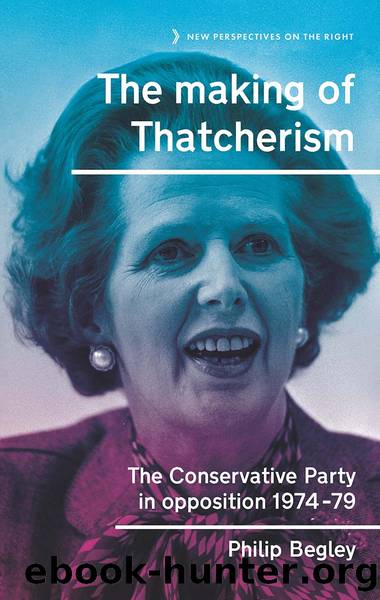
Author:Philip Begley [Begley, Philip]
Language: eng
Format: epub
Tags: Political Ideologies, Comparative Politics, Political Science, Conservatism & Liberalism, General
ISBN: 9781526131324
Google: hHTnDwAAQBAJ
Publisher: Manchester University Press
Published: 2020-05-15T10:59:16+00:00
6
Immigration
Rivers of blood
Britain in the 1970s often appeared to be defined by fear and uncertainty.1 The decade arguably witnessed a subtle yet discernible change in atmosphere.2 There can be little doubt that it witnessed a change in tone. If there was one issue which cut across popular concerns about economic decline, governability and morality, it was immigration. The 1970s was the most propitious post-war decade for these kinds of fears.3 It was a period of high inflation and unemployment.4 There was a moral backlash against the decadence and liberalisation of the 1960s.5 Popular fears about terrorism, the future of the United Kingdom and Britainâs place in the world, and the inability of weak governments to confront all of these problems, contributed to the sense of uncertainty and a rise in social tension.6 Race and immigration became significant political issues during the 1970s.7
This was at times a period of political extremism. In this environment it is perhaps unsurprising that the National Front (NF) should rise to prominence, and the group had a significant impact during this period, particularly on the Conservative Party. Founded in 1966, bringing together a number of right-wing factions, it combined a powerful anti-immigration agenda and provocative tactics.8 Its membership rapidly increased and it began to enjoy sudden surges of electoral support.9 The NF helped to change the landscape of the 1970s. Race and immigration were firmly on the political agenda.
Nonetheless, if we are to avoid an arbitrary and undeservedly negative picture, it is also important to recognise that there was much more to the decade. The 1970s had weaknesses just like any other period, but there were also positive continuities. As discussed in previous chapters, this was a time of rising prosperity for many Britons.10 It was also a period of a real influence on British customs from overseas; in Arthur Marwickâs famous phrase, immigration and multiculturalism allowed Britain âto acquire a new cosmopolitanism without shedding its old xenophobiaâ.11 Although there were negative messages, most leading political parties, and indeed many Britons, continued to recognise the positive contribution that immigrants had made and the importance of maintaining good race relations. A true picture of the 1970s must also recognise the significance of movements like Rock Against Racism and the Anti-Nazi League.12 The entry of groups like the National Front into electoral politics acted as a catalyst for anti-fascist and anti-racism movements across Britain, which made a very different kind of appeal.13 Their concerts, marches and demonstrations were the culmination of a new, young, left-wing political activism that had built up during the 1960s and 1970s.14 Their most important contribution may have been to brand the National Front and its philosophy as inherently un-British and unacceptable in a tolerant society.15 When it comes to race and immigration therefore, the 1970s were a period of clashes and complexities.
In 1977, the Marxist academic Tom Nairn presented perhaps the best-known examination of racism and nationalism in Britain at the time.16 Nairn argued that the concepts of race and nation were closely related, and that the former essentially derived from the latter.
Download
This site does not store any files on its server. We only index and link to content provided by other sites. Please contact the content providers to delete copyright contents if any and email us, we'll remove relevant links or contents immediately.
The Vikings: Conquering England, France, and Ireland by Wernick Robert(84612)
Ali Pasha, Lion of Ioannina by Eugenia Russell & Eugenia Russell(40392)
The Conquerors (The Winning of America Series Book 3) by Eckert Allan W(39239)
The Vikings: Discoverers of a New World by Wernick Robert(37052)
Cecilia; Or, Memoirs of an Heiress — Volume 1 by Fanny Burney(32731)
Cecilia; Or, Memoirs of an Heiress — Volume 2 by Fanny Burney(32099)
Cecilia; Or, Memoirs of an Heiress — Volume 3 by Fanny Burney(32077)
Empire of the Sikhs by Patwant Singh(23212)
The Secret History by Donna Tartt(19484)
Hans Sturm: A Soldier's Odyssey on the Eastern Front by Gordon Williamson(18730)
Cat's cradle by Kurt Vonnegut(15574)
Pimp by Iceberg Slim(14807)
Sapiens: A Brief History of Humankind by Yuval Noah Harari(14563)
Norse Mythology by Gaiman Neil(13589)
Talking to Strangers by Malcolm Gladwell(13565)
Leonardo da Vinci by Walter Isaacson(13536)
4 3 2 1: A Novel by Paul Auster(12632)
Underground: A Human History of the Worlds Beneath Our Feet by Will Hunt(12240)
The Radium Girls by Kate Moore(12209)
